Showing posts with label Advocacy. Show all posts

Monday, December 12, 2011

financial disadvantage = educational disadvantage


There was a very interesting article in the NY Times, this weekend that I think warrants further exploration and discussion.  The article dealt with the topic of income inequality and overall school performance.  Its premise is that children who happen to be born into financially disadvantaged households perform markedly worse in school on average than their peers from more affluent backgrounds. 
This income/performance disparity is a proven fact and I will not even attempt to dispute this as it has been abundantly documented, most notably in the Equality of Educational Opportunity (Coleman) Study (EEOS), 1966 also known as the Coleman Report.  The Coleman Report was commissioned by the US Department of Health, Education, and Welfare in 1966 to assess the availability of equal educational opportunities to children of different race, color, religion and national origin.  This is an example of how use of a social survey was an instrument of national policy-making.  More recently Sean F. Reardon of Stanford University published a paper entitled, Income Inequality and Income Segregation (2010).  Reardon determined both income inequality and income segregation in the United States grew substantially from 1970 to 2000.  His study investigates whether and how income inequality affects patterns of income segregation along three dimensions—the spatial segregation of poverty and affluence; race-specific patterns of income segregation; and the geographic scale of income segregation.  In short, the achievement gap between children from high- and low-income families over the last 50 years now far exceeds the gap between white and black students.  This fact is as thought provoking as it is disturbing.  The National Assessment of Educational Progress shows that more than 40 percent of the variation in average reading scores and 46 percent of the variation in average math scores across states is associated with variation in child poverty rates.  Unfortunately, international research tells a similar story.   Results of the 2009 reading tests conducted by the Program for International Student Assessment show that, among 15-year-olds in the United States and the 13 countries whose students outperformed ours, students with lower economic and social status had far lower test scores than their more advantaged counterparts within every country.  The statistic belies the following question: can it be possible that the substandard performance of American students on international tests be unrelated to the fact that one-fifth of American children live in poverty?
Thus far, American policy makers continue to take the stance that since they cannot change the backgrounds of students and consequently should focus on the things that they can control.  For example, President George W. Bush’s signature education law, No Child Left Behind, set unrealistic expectations for the nation’s schools.  While President Barack Obama has instituted policies that have primarily concentrated on encouraging school efficiency through judging teacher performance using the test scores of their students as well as promoting the creation of charter schools to encourage competition. 
Federal education policy seems to want to bring all students to high levels of achievement but has taken no consideration for the challenges that disadvantaged students may face.  Can schools alone offset the effects of poverty?  Does the fact that some schools “make it” or “beat the odds” make it reasonable to expect that all schools will or should?  Are the effects of a few years of high quality education enough to make a significant impact in the lives of underprivileged children over the long term?  Can we really address education as a singular issue?  Since education policy makers can’t take on poverty itself, should they try to provide poor students with the social support and experiences that middle-class students enjoy as a matter of course? 
As NYC continues to struggle to open more charter schools where children have access to free and excellent education with no zip code encumbrances, the questions for me are some of the ones I posed to you, my readers.  Frankly, I'm on the fence about whether or not the academic gains are long term and charter models can be scaled up to address the needs of larger populations of disadvantaged students.  We cannot ignore that families that deal with financial crisis on a daily basis don't have the where-with-all let alone the resources to invest in enriching activities, especially during the summer months when the most learning loss occurs.  Low-income parents are in a constant struggle to provide basic care such as food, clothing, housing and the provision of adequate medical care to their families.  Given that national and state budgets are stretched and the weighty political power of conservative groups aren't likely to dedicate a significant amount of effort to the goal of poverty reduction at this time in our history, I'm not certain what this means for the low-income and financially disadvantaged children across our nation over the long haul.  I am certain, however, that having access to a high quality education, if only for a few years, will certainly not hurt.    
Weigh in faithful readers… put on your thinking caps and let’s go WAY BEYOND Z!      

Thursday, February 17, 2011

Is charter school for my child??

On January 16, 2011, I posted an article about HSA opening a school in Brooklyn.  One of the comments posted to the blog was from a parent of a 4-year-old boy who was seeking advice regarding choosing a school for his/her child.  I get this question so often that I felt my response deserved a post of it's own.  Thank you "Anonymous" for  asking and I hope that you find my response helpful.  In addition, I encourage anyone else to post constructive comments to this post.


Anonymous said...
I am the parent of a 4 year old son who is currently attending pre-k and will be attending kindergarten this September. My husband and I have been searching high and low for a school that is the right fit for our son. We would like him to be in an atmosphere where he is getting the best education offered as well as in an environment where he can be himself (a child). What we are finding so far (which is just from speaking with staff and parent's) is that education wise the charter schools surpass the other schools but we are a little leary because they seem to be a lot more militant. Don't get me wrong structure is great but boot camp is not! We would like our son's school experience to be one that he enjoys and learns a great deal from.
Does any parent who has children in Charter schools have any advice/comments?

As you have surely figured out by now, I am the parent of two charter school students.  I am in total agreement with you that your son's early school experience is one that should inspire a life long love of learning not an environment where all semblance of fun is dashed away in favor of drills and regimented activity.  I will begin by saying that all charter schools are not created equally and I encourage you to visit any and all charter (and non-charter) schools that you may be considering sending your son to.  Only you know your child and what type of environment may be a good fit for him.  I also firmly believe in checking the track record of student achievement at any school that you may be considering.  I find it hard to believe that failing or poor performing schools will turn their success rate around in the space of a school year and a year in the academic life a young child is way too important to sacrifice for a poorly thought out choice.


My experiences with the Harlem Success Academy have been outstanding!  I love the disciplined environment where negative behavior is curbed immediately so that real learning can take place.  Children are expected to listen attentively and respectfully when others are speaking and raise their hands when they want a turn.  Hallways and classrooms are kept tidy not by punishing children or shaming them into cooperation but by instilling a sense of cooperative responsibility for shared space.  Negative behaviors are met with real world consequences such as loss of rewards or short spells spent away from the main core of the student group which is usually engaged in a fun and interactive learning activity.  Classrooms are bright and engaging and active thinking, group discussion and participation are encouraged.  Science is offered 5 days a week beginning in Kindergarten and every science lesson is hands-on with children participating in experiments followed up with discussions about their observations.  All children participate in "specials" classes which include chess, art and music where once again they are engaged in fun activities while learning to play chess, an instrument or creating amazing works of art.  


As far as boot camp... if that is what some choose to refer to it as, then my children wake me up at 5:30 every weekday morning from August to June and eagerly subject themselves to it!  Most of the scholars are unhappy about not seeing their friends and teachers on weekends and during the summer break.  Yes, there is a level of indoctrination.  HSA students (and their families) will refer to themselves as scholars and recite their college and anticipated year of graduation without being asked.  They will also interject when they observe you not adhering to the school's ACTION values which include Agency, Curiosity, Try and Try, Integrity, Others and No shortcuts.  I have also been subjected to verse after verse of school songs and cheers that are unique to each school location.  My kids are extremely pushy when it comes to reading to them and ensure that I do so whether or not I want to, as parents are also required to complete reading logs of books read to their scholars.  In short, the HSA community is less of a boot camp and more of a way of life.  HSA happens to be aligned with things that I value and find agreeable.  Ensure that any school that you choose for your child is a comfortable fit for your family.  
      

Monday, January 31, 2011

The Audacity of Hope... in Akron

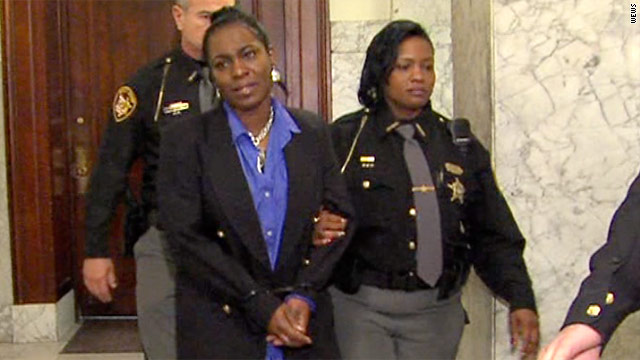
So, by now I'm sure that everyone has heard of Kelley Williams-Bolar, from Akron, Ohio who was arrested, indicted on two felony Larceny charges and imprisoned.  This whole fiasco came as a result of her trying to seek-out a quality education for her daughters outside of the drug-ridden and failing schools that were available to them by virtue of their zip code.  Yes, this woman was arrested, indicted, and imprisoned for being poor and having the audacity to want better for her children!  Sadly, this is what happens when there aren't any educational choices available to families who do not have the means to pay for a private education when the only free education available to them is sub-standard.

Mother who put kids in wrong school released from jail early
Ohio mother Kelley Williams-Bolar is led off to jail after her conviction.    


America has certainly lost its way when municipalities would rather spend tax-payer monies to prosecute parents who attempt to improve the lot of a child than use the same tax dollars to educate said child.  This is shameful, and as a society, we should all be embarrassed.  Use your heads America!  Parent Choice is a necessary option.  I agree that traditional public education should be reformed; however, I also firmly believe there has to be a more immediate interim solution.  Parents need options while the slow bureaucratic wheels of the Department of Education turn. 


Read the following commentary on the sad tale of the Ohio mother by Roland Martin, CNN Political Journalist:      
Ohio woman jailed for sending kids to school just wanted a choice
By Roland S. Martin, CNN Political Contributor
January 29, 2011 9:29 a.m. EST
tzleft.roland.martin.cnn.jpg
STORY HIGHLIGHTS
  • Roland Martin says Ohio mom's actions are no surprise
  • She wanted to make sure her children got a quality education, he says
  • We have an education system that is unequal, unfair and not equitable, he says
  • He proposes voucher system that would allow various kinds of education
Editor's note: Roland Martin is a syndicated columnist and author of "The First: President Barack Obama's Road to the White House." He is a commentator for TV One Cable network and host/managing editor of its Sunday morning news show, "Washington Watch with Roland Martin."
(CNN) -- If you lived in a crime-ridden neighborhood where your home was broken into a dozen times and the school your children were zoned to was low-performing, wouldn't you take drastic measures to ensure they got a quality education?
That's exactly what Kelley Williams-Bolar did, pulling her 12- and 16-year-old daughters out of the decrepit school they attended in Akron, Ohio, and enrolling them in a suburban district where her father lived.
Williams-Bolar used her father's address, where she alleges she lived part-time. Yet the Copely-Fairlawn School District felt she was lying about being a resident, and hired a private eye to follow her, videotaping Williams-Bolar leaving her public housing home and dropping her children off at the suburban school.
They confronted Williams-Bolar, demanded that she repay the district $30,000, saying she didn't have the right to have her daughters in the district since she wasn't a taxpayer.
When she refused, Williams-Bolar was indicted on two felony charges, found guilty and sentenced to 10 days in prison. Because of the felonies on her record, the aspiring schoolteacher will never be able to enter the classroom.
Once the story hit the national media, it led to significant coverage, angering folks nationwide.
Some see this as an issue of race: The mother and her children are black; the district is largely white.
But that really isn't the fundamental issue. What this problem should highlight for anyone is the clear disparities in urban and suburban school districts, and how we have an education system that is unequal, unfair and not equitable.
Too many Americans are delusional in thinking we have a national education system that is fair. It isn't. We all know that you can go from community to community and see some elementary, middle and high school campuses that look like college campuses, while others look like prisons.
Those districts with money hire teachers with master's degrees and Ph.D.s; those with little money rely on those with only teacher certificates. Those with money can invest in iPads and laptops; those without are thankful just to have enough chalk, erasers and pencils. It's so bad that teachers nationwide often dip into their own pockets just to purchase school supplies for many of their students. Yet well-to-do schools might have athletic complexes that rival universities in top athletic conferences.
Did Williams-Bolar break the law? Yes. Was the sentence she was given fair? Of course not. And I dare say many of us, when faced with a school system that will put our children further and further behind the learning curve, would have a "by any means necessary" focus to ensure they had the best chance to succeed.
In his State of the Union address, President Barack Obama presented his bold vision to transform our nation's education system, but when the bulk of dollars come from local property taxes, there isn't much the federal government can do.
That means if you live in a well-off neighborhood, you're likely to see thousands more dollars being spent on education in that district than in districts where the property values are much lower.
The jailing of Williams-Bolar also raises the controversial issue of school choice. The Obama administration says it fully supports school choice, but that is limited to charter and magnet schools.
I've long contended that all choices should be presented to parents, including vouchers, allowing those from the worst-performing schools to be able to take the dollars allocated for their child and enroll in a private or parochial school.
If we are going to truly confront the education crisis in this country, nothing should be off the table. Whether we like it or not, there is no one way to educate a child. Take your pick: public school, private school, home school, charter schools, technical schools, college preps, ROTC academies, magnet programs, all-male, all-female, even online-only schools. You name it, I'm for it.
All Williams-Bolar wanted was for her kids to have a shot. And at the end of the day, that's what we all should want. But it is going to require men and women of conscience to stop with our attitude of protecting what we see as ours and be willing to create an educational system that is truly one this nation could be proud of.
The opinions expressed in this commentary are solely those of Roland S. Martin.

Saturday, January 22, 2011

Repost of Trapped By a Zip Code

As the 2011 advocacy season is well under way for those of us who want to see the Charter School Movement grow and thrive, I thought to repost an entry that I originally posted on April 26, 2010.  This post speaks to the warehousing of children in failing schools in poor school districts.  This issue of having children bound to failing schools based on nothing other than their zip code, for me, is one of the primary reasons to to open the playing field and enhance the realistic educational choices available to parents in reference to acquiring a free and excellent education for their children.  Happy reading, and a HSA roller coaster cheer for those of you who become motivated and get involved after reading Way Beyond Z!      


Trapped By A Zip Code
NYC Public Charter Schools are under fire, and as a result may be legislated right out of business. As the insults fly, angry mobs of picketing, flyer-shoving parents form and politicians strategize how best to woo their constituents, the youngest, and among the most vulnerable of our citizenry, are being ignored and overlooked. The real victims or beneficiaries of this less than civil discussion are the one million or more school aged children who’s present and future are tremendously affected by the decision whether or not to allow them access to a free, quality education. Charter Public Schools are free, independently run public schools open to all New York City students. They are innovative in terms of policy and curriculum and the students are diverse. Public Charter Schools are an environment where teachers are empowered and schools are accountable. They serve regular as well as special education students and unfortunately do more with less operating funds.

My story is not so unique. My family and I live in the Mott Haven section of the Bronx. Well before the age at which my children would begin their formal education, my husband and I began to search for performance statistics of my neighborhood public schools. Much to my dismay, I found dismal statistics in reading and math and also realized that most traditional public elementary schools have not the resources, or so I believed, to teach science in primary school. I contacted schools outside of my district in reference to admission practices only to find out that my children would require a much coveted waiver in order to place my children outside of their neighborhood and in a better performing public school. It seemed that they were being held captive by their parents’ choice to live in Mott Haven. Being a product of private and parochial schools, I considered this a viable option, only to find out that these spaces are also coveted and scholarship funding is reserved only for the exceptionally academically gifted or most impoverished. My children fit neither of these descriptions. We were faced with making the decision that all parents dread. Accept sub-standard education that my children would receive because of their unfortunate zip code or sacrifice basic necessities to educate them properly. 

Let’s think “beyond Z” people! Children and their parents who happen to have zip codes that tether them to failing schools are expected to accept this as their only option or make the decision to live from hand to mouth in order to pay for a private education. Unfortunately, time stands still for no one and the children of New York City don’t have time for an ailing school system to be revived when there are excellent public charter schools now. I wish for all NYC children to be the beneficiary of a free, quality education not the victims of political opportunists who are only concerned with securing their seats in the upcoming election. I now pose this question to all New Yorkers, “What do you expect for the children of our city, access to excellence or mediocrity?” Frankly, even one school year is too much time to waste, much less an entire elementary education. You decide… 

Have a Beyond Z Day!

Charter Schools Outperform Traditional Public Schools

The National Center for Policy Analysis (NCPA) has issued a report via their Daily Policy Digest on January 21, 2011.  This report strongly suggests that public charter schools outperform traditional public schools.  Some points are listed below and a link is provided so that you can view the entire policy brief.  

  • Principals at charter public schools are allowed to control their budgets, teaching staff and educational programs with little or no central bureaucratic control.
  • States with well-designed charter schools hold administrators accountable for student performance.
  • Charter public schools that consistently fail to educate students can be closed or placed under new management.
According to Finne's study:
  • Charter public schools are popular with parents -- 365,000 students are on waiting lists to attend a charter public school.
  • Across the nation, over 1.7 million children now attend 5,453 charter public schools -- this number increased by 9 percent in 2010 alone.
  • Well-run charter public schools perform significantly better than traditional public schools.
  • Charter public school students are no different in academic background and motivation than students attending traditional public schools.
  • Charter public schools in Massachusetts and elsewhere have closed the achievement gap between minority and white students.


Charter Schools Outperform Traditional Public Schools

Sunday, December 26, 2010

Joel Klein is proud of his legacy as a disruptive force... and so are we!

Joel Klein, who officially steps down as the Chancellor of NYC Schools this upcoming Friday, had an exit interview of sorts last week after a visit to the Urban Assembly School for Applied Math and Science in the Bronx.  During this interview he listed empowering Harlem parents with choice as his greatest success!  Overall, he feels proud of his legacy as a disruptive force.  

Kiss your brain Joel Klein!  You've gone Way Beyond Z for the children of New York City!  You may have been thought a tyrant, political opportunist or tone-deaf bureaucrat by some, but for public charter school parents, scholars and advocates you will be fondly remembered as a fair and bell-clear voice in the wilderness of DOE bureaucracy.  During your eight year tenure, you were a tireless advocate and gave voice to the youngest and most vulnerable segment of our citizenry... children, who in this case, are tethered to failing schools by their parents' choice of neighborhood or inability to relocate to a more affluent zip code.  

The full article, published by the NY Times, may be read by accessing the following link:
            

Monday, December 20, 2010

Success Charter Network Hosts Reception for Chancellor Joel Klein


On Friday, December 10, 2010, a reception for Joel Klein was held at the Charter Success Network Offices in Harlem.  The small and personal gathering was held to thank Joel Klein for all his hard work and unwavering support of parent choice and Public Charter Schools during his eight year tenure as the NYC School Chancellor.


Chancellor Klein gave a rousing speech regarding the importance of taking up his torch and moving the parent choice movement ahead, despite his imminent absence at the forefront of the movement.  Klein has been well known for his expansion of small schools and charter schools to provide more high-quality educational options for students.  He encouraged all in attendance to never give up on the children of the City of New York.


Eva Moskowitz, Founder of the Success Charter Network addressed the gathering as did Ex-Senator Craig M. Johnson (D-Nassau).  Senator Johnson, who lost his seat to Senator elect Martin after two terms, is a staunch supporter of public charter schools and parent choice.  


Saturday, December 11, 2010

Joel Klein is awarded the HSA3 2010 Beyond Z Award


back row: Sabrina Williams (HSA1), LiSandra Rivera (HSA3), John Bosley (HSA3)
middle row:  Tom Perna (HSA1), Mashairi Motta (HSA3), Chancellor Joel Klein, Glo Anderson-Flete (HSA3)
front row: Ny Whittaker (HSA3), Valencia Motta (HSA3)   
A representative group of Harlem Success Academy (HSA) parents joined the HSA3 Parent Council Executive Committee (PCEC) on the stairs of the Tweed Courthouse in lower Manhattan on Wednesday, December 8th as they awarded outgoing NYC School Chancellor, Joel Klein with the 2010 Beyond Z Award.

The chancellor was awarded a framed certificate, thank you cards and a Harlem Success Academy themed gift basket in appreciation for his unwavering support of parent choice and Public Charter Schools during his eight year tenure as the NYC School Chancellor.  

At one point during the meeting, Chancellor Klein was visibly touched and moved to tears when a current Harlem Success Academy parent recounted his tale of trying to educate an older child in the NYC traditional Public school system before charter schools and parent choice were an option.  “Traditional public schools failed my oldest child.  There is no comparison between the rigorous curriculum and total-child focus of public charter schools and what I was offered in traditional public schools before all of this was an option.  My youngest son is thriving.  Thank you, Chancellor Klein for being our champion for change.  My family thanks you.” said parent, John Bosley, with tear filled eyes.   

Chancellor Klein lamented about the inequity of not being able to find good quality, free education 56 years after the Brown vs. The Board of Education ruling.  Brown vs. The Board of Ed was a landmark decision of the United States Supreme Court that declared state laws establishing separate public schools for black and white students unconstitutional. The decision overturned the Plessy v. Ferguson decision of 1896 which allowed state-sponsored segregation. Handed down on May 17, 1954, the Warren Court's unanimous (9–0) decision stated that "separate educational facilities are inherently unequal." As a result, racial segregation was ruled a violation of the Equal Protection Clause of the Fourteenth Amendment of the United States Constitution.  This ruling paved the way for integration and the civil rights movement.  He encouraged parents to fight tirelessly for what they believe in even after his departure from the office of the Chancellor.  

The event was covered by Fox 5 new and aired at 5 o’clock and 11 o’clock on December 8th.  


Sunday, December 5, 2010

Joel Klein: What I Learned at the Education Barricades - WSJ.com

This is a fascinating article that was published in The Wall Street Journal this morning.  Klein, who has always been a friend of charter schools and parent choice, gave a major kudos to Harlem Success Academy in the second paragraph!  Roller Coaster Cheer for Chancellor Klein!!  
Over the past eight years, I've been privileged to serve as chancellor of the New York City Department of Education, the nation's largest school district. Working with a mayor who courageously took responsibility for our schools, our department has made significant changes and progress. Along the way, I've learned some important lessons about what works in public education, what doesn't, and what (and who) are the biggest obstacles to the transformative changes we still need.
First, it is wrong to assert that students' poverty and family circumstances severely limit their educational potential. It's now proven that a child who does poorly with one teacher could have done very well with another. Take Harlem Success Academy, a charter school with all minority, mostly high-poverty students admitted by lottery. It performs as well as our gifted and talented schools that admit kids based solely on demanding tests. We also have many new small high schools that replaced large failing ones, and are now getting outsized results for poor children.
Second, traditional proposals for improving education—more money, better curriculum, smaller classes, etc.—aren't going to get the job done. Public education is a service-delivery challenge, and it must be operated as such. Albert Shanker, the legendary teachers union head, was right when he said that education has to be, first and foremost, about accountability for "student outcomes." This means there must be "consequences if children or adults don't perform."
When Mayor Bloomberg and I started, there was zero accountability. Instead, bureaucrats, unions and politicians had their way, and they blamed poor results on students and their families. When we talked about managing the system with organizational practices that work in every other sector of our economy—like accountability, incentives and competition—we were told that education isn't a business. Maybe so, but whether it's health care, education or any other service, poorly-structured, nonaccountable delivery systems cost a fortune and don't work.
To counter the dysfunction, we turned the system upside down. We empowered principals, giving them new authority over budgets, hiring and other programs. In return, we held them accountable for student outcomes, rewarding them for success or removing them and closing their schools for poor performance. To attract and retain strong teachers, we raised salaries substantially and paid more to our best teachers who agreed to transfer to low-performing schools. We also increased choices for families by replacing almost 100 failing schools with about 500 new, small schools designed with community and charter management groups. Multiple studies showed that these new choices yielded significantly better results. Competition works.
Getty Images
A math class at the Harlem Success Academy charter school.
Our embrace of charter schools was especially controversial. But why should any student have to settle for a neighborhood school if it's awful? The debate shouldn't be about whether a school is a traditional or charter public school. It should be about whether it's high-performing, period. Low-income families deserve the ability to make the best choices for their kids, as more financially secure families always have.
Changing the system wasn't easy. The people with the loudest and best-funded voices are committed to maintaining a status quo that protects their needs even if it doesn't work for children. They want to keep their jobs by preserving a guaranteed customer base (a fixed number of students), regardless of performance.
We have to rid the system of this self-serving approach. We must stop protecting ineffective teachers and stop basing layoffs on a last-in/first-out rule. With federal stimulus dollars running out, budgets are only going to get tighter and layoffs will be necessary. When that happens, do we really want to lose the talented and energetic new teachers we have hired in the last few years?
Finally, we need to innovate, as every successful sector of our economy does. The classroom model we have used since the 19th century, in which one teacher stands in front of a room of 20-30 kids, is obsolete. We should be making the most of new technology and programs that help teachers deliver personalized instruction and allow students to learn at their own pace. In New York City we've experimented with new models and seen great promise, but it will take larger investments to see real results.
As I leave the best job I've ever had, I know that more progress is possible despite the inevitable resistance to change. To prevail, the public and, most importantly, parents must insist on a single standard: Every school has to be one to which we'd send our own kids. We are not remotely close to that today.
We know how to fix public education. The question is whether we have the political will to do it.
Mr. Klein is the outgoing chancellor of the New York City Department of Education. In January he will become an executive vice president of News Corporation, which owns the Journal.

*This article can also be accessed through the link below or copy and paste the entire address into your web browser.


http://online.wsj.com/article_email/SB10001424052748704104104575622800493796156-lMyQjAxMTAwMDAwMzEwNDMyWj.html